D
H
M
S
Lock in this year's prices on all our tours.


The Cotswolds. Without question, one of the most beautiful landscapes in England. One of the most visited day trips from London, one of the most photographed regions in Britain, and home to a concentration of famous residents that would make most city neighbourhoods blush. Kings, supermodels, rock stars, Hollywood actors, American icons, and at least one very famous television presenter with a farm. If you're planning a Cotswolds tour from London and wondering where to start, what to see, and why so many people who could live anywhere in the world have chosen to live here, this is your guide.
About an hour and a half drive from London, the Cotswolds is an Area of Outstanding Natural Beauty covering nearly 800 square miles across Gloucestershire, Oxfordshire, Wiltshire, Worcestershire, and Warwickshire. It's the largest AONB in England and Wales, a protected landscape whose character has remained essentially unchanged for centuries. That's precisely why it looks the way it does.

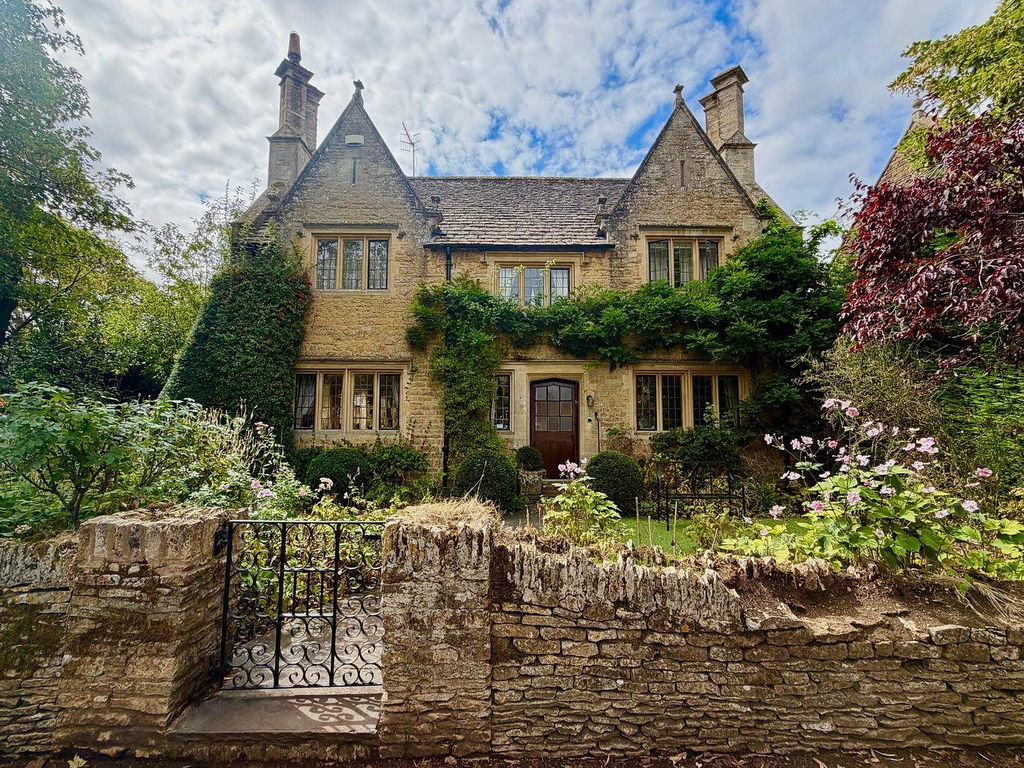
The name itself gives you the key. "Cotswold" derives from Old English, roughly translating as "sheep enclosure in the rolling hills." Those two things, sheep and hills, are the whole story of this landscape. The geology is Jurassic limestone formed around 200 million years ago, rich in iron oxide and fossils, which gives the stone its distinctive warm gold colour. Every wall, every cottage, every barn and church in the Cotswolds is built from the same stone pulled from the same ground. The result is a landscape of remarkable visual consistency, as if the whole region was designed by a single architect with very good taste and unlimited patience.
It's that consistency, that sense that nothing jars, nothing clashes, everything belongs, that makes the Cotswolds so compelling. And so addictive. People who visit once tend to come back. People who come back tend to start looking at property. And some of the people looking at property have rather large budgets.
The Cotswolds looks the way it does because of sheep. That sounds reductive, but it's genuinely true, and understanding it makes the landscape far more interesting than it first appears.
From the 12th century onwards, the wool industry was the backbone of the English economy, and the Cotswolds was its beating heart. A local breed, nicknamed the "Cotswold Lions" for their long, lustrous fleeces, produced wool of such exceptional quality that it was traded across Europe from Italy to Flanders. The merchants who brokered these deals became immensely wealthy, and they spent their money in the obvious ways: building grand churches, market halls, and manor houses in their home villages. The result was an explosion of construction in the 14th and 15th centuries, all in local stone, all of a piece, all of it still standing today.
When you walk the main street of a Cotswolds town, or stand in an ancient market square, or look at the impossibly grand wool churches that dominate village after village, you are looking at the physical legacy of medieval wool money. These weren't built to be picturesque. They were built to be impressive. The picturesque part happened later, when the money ran out and nothing got knocked down to replace them. The Cotswolds is, in the most literal sense, a landscape preserved by economic decline. It has never looked better for it.
The Cotswolds has dozens of villages worth visiting, each with its own character, history, and reason to stop. Here are the ones that appear most often on our tours, and what makes each of them worth your time.
|
Bibury Frequently described as the prettiest village in England, a description first applied by designer and craftsman William Morris in the 19th century. The centrepiece is Arlington Row: a terrace of weavers' cottages dating from the 1380s, built originally as a monastic wool store and later converted into homes for cloth workers. It is one of the most photographed streetscapes in Britain and one of the images most closely associated in the world's imagination with "English village." The River Coln running through the village, the trout farm, the ancient church. Bibury is small. Go on a relaxed circular walk, sit by the river, or have a drink in the old coaching inn. |

|
Bourton-on-the-Water Known, perhaps affectionately and perhaps slightly fancifully, as the Venice of the Cotswolds. A reference to the series of low stone bridges crossing the River Windrush as it flows through the centre of the village green. It's one of the most popular stops on any Cotswolds tour from London, and deservedly so. The village manages to be genuinely charming even when busy, and the walk along the river in either direction is lovely. |

|
Stow-on-the-Wold Sits at the highest point of the Cotswolds at around 800 feet, and has been a market town since 1107. At its peak, as many as 20,000 sheep were traded here in a single day. Stow has two other claims to fame worth knowing. The Church of St Edward reportedly inspired JRR Tolkien's description of the doors of Moria in The Lord of the Rings: a pair of ancient yew trees flank its north entrance in exactly the way Tolkien described. And the Porch House on Digbeth Street is said to be the oldest inn in England, with origins dating to 947 AD. Stow was also the site of the final battle of the English Civil War in March 1646, when Royalist forces made their last stand here and lost. Oscar-winning actress Kate Winslet, who owns a cottage nearby, is occasionally spotted in the town. Proof that even Hollywood royalty chooses Stow for a quiet weekend. |

|
Burford Perhaps the most complete medieval town in the Cotswolds. A single long high street descending a hill to a bridge over the River Windrush, lined with buildings from almost every century between the 14th and 18th. The church at the bottom is magnificent. The independent shops and cafés along the street are excellent. Jeremy Clarkson's pub, The Farmer's Dog, sits just outside Burford, part of the wider empire our Clarkson's Farm tour explores in full. Burford feels less visited than some other Cotswolds towns, which makes it more rather than less rewarding. |

|
Castle Combe Sits at the southern edge of the Cotswolds in Wiltshire, and is regularly voted the prettiest village in England, a title it contests with Bibury in what is, frankly, a competition with no wrong answer. What sets Castle Combe apart is how complete it feels. There are no modern intrusions, no inappropriate signage, no architectural apologies for the present day. A medieval market cross stands in the centre. The Manor House hotel, parts of which date to the 14th century, anchors one end. The Church of St Andrew, whose tower has loomed over the valley since the 13th century, anchors the other. The By Brook, a clear, fast-running Cotswolds stream, runs beneath stone bridges at the bottom of the village. Castle Combe has appeared on screen more times than most villages manage in several lifetimes. It doubled as the English village of Puddleby-on-the-Marsh in the 1967 film Doctor Dolittle. It has stood in for countless English period dramas since. And yet it remains relatively un-overrun, tucked into a steep wooded valley that insulates it from the outside world in a way that feels almost deliberate. Arriving in Castle Combe for the first time has a quality of discovery that more famous destinations rarely match. |

Here is something worth knowing before you arrive: the Cotswolds is not merely beautiful. Acre for acre, it is the most star-studded countryside in Britain, and possibly in Europe.
King Charles III has kept Highgrove House near Tetbury as his private country retreat since 1980, tending its famous gardens for over four decades. Princess Anne lives at Gatcombe Park near Minchinhampton. The Cotswolds has been royal territory for a long time.
But the celebrity story really accelerated with what became known as the Chipping Norton set, a loose circle of high-profile neighbours around the north Oxfordshire market town that at various points included former Prime Minister David Cameron, Jeremy Clarkson, media figures, and a remarkable concentration of cultural influence in a relatively small radius of Cotswolds countryside. Clarkson, of course, is now most famous locally not for Top Gear but for Diddly Squat farm and the television series it spawned, which has turned the area around Chipping Norton into a pilgrimage destination in its own right. Our Clarkson's Farm tour from London takes you right through this territory.
David and Victoria Beckham bought a multi-million pound converted barn on the Great Tew estate near Chipping Norton in 2016, and the Cotswolds has featured prominently in their public life since: in their Netflix documentary, their social media, and David's much-discussed beehives. Blur bassist Alex James owns a 200-acre farm in Kingham, where he makes cheese and hosts the annual Big Feastival with chef Jamie Oliver. Kate Moss has a cottage in west Oxfordshire. Hugh Grant has long had a country retreat in the region. Artist Damien Hirst, Britain's wealthiest living artist, purchased the 300-room Victorian Gothic Toddington Manor near Cheltenham and turned it into a private residence and gallery.
And then the Americans started arriving. Ellen DeGeneres and her wife Portia de Rossi moved to the Cotswolds, drawn (like so many before them) by the combination of real beauty, genuine privacy, and the fact that London is still less than two hours away. Taylor Swift and Travis Kelce stayed in a property near Great Tew during the UK leg of the Eras Tour, choosing the Cotswolds as their hideout from the outside world. The area has become, as one estate agent memorably put it, Britain's stealth wealth headquarters: a place where considerable privilege wears muddy boots and shops at the farm shop.
That farm shop is Daylesford Organic near Kingham, founded by Lady Carole Bamford and now one of the most influential food and lifestyle destinations in Britain. It's the place where you're as likely to encounter a Cabinet minister as a Hollywood star reaching for the same jar of organic honey. The Cotswolds, it turns out, has a gravitational pull that operates across all nationalities and tax brackets.
None of this, it should be said, makes the Cotswolds feel celebrity-obsessed or exclusionary. The villages are still the villages. The pubs are still the pubs. The lanes are still the lanes. Famous residents are simply part of the fabric here, treated with the same polite discretion that the Cotswolds extends to everyone. The point is not to spot them. The point is to understand why they chose to be here, in this landscape, above all others. When you arrive, you'll understand immediately.
The celebrity story is recent. The history goes back considerably further.
The Civil War is everywhere in the Cotswolds once you know to look for it. This was Royalist country, and the battles fought here between 1642 and 1646 shaped the future of British democracy. Edgehill, on the northern edge of the region, was the very first pitched battle of the entire conflict. Stow-on-the-Wold, as already noted, was the last. Between those two moments, the Cotswolds lived through years of occupation, requisition, and violence that left almost no physical trace but enormous historical significance.
The wool churches, built from the profits of the medieval wool trade, are another layer entirely. These are not modest country churches. They are vast, ambitious, almost cathedral-scale buildings in tiny villages, and their scale makes sense only when you understand the immense wealth that built them. Walking into one of these interiors from a quiet Cotswolds street is one of those moments of unexpected grandeur that the region does particularly well.
William Morris, the textile designer and socialist thinker who more or less invented the Arts & Crafts movement, fell in love with the Cotswolds in the 1870s and made Kelmscott Manor, near Lechlade, his summer home for the last 25 years of his life. Morris saw in the Cotswolds landscape and its vernacular architecture (hand-built, local, honest) everything he thought the industrial age was destroying. His philosophy, which influenced design worldwide, grew from what he found here.
Tolkien wove the Cotswolds landscape into the Shire, the pastoral, unhurried, deeply English homeland of the hobbits. The rolling hills, the village greens, the ancient pubs, the sense that history runs very deep and nothing much needs to change. It's all there in the pages of The Lord of the Rings if you know what you're looking at. Walking through a Cotswolds village on a quiet morning is the closest most people will ever get to feeling they've stepped into Middle-earth. That's not an accident.
The Cotswolds is roughly 80 to 100 miles from London, which makes it entirely feasible as a day trip, but only if you plan carefully, or let someone else plan for you.
By train, you can reach Moreton-in-Marsh or Kingham in around 90 minutes from Paddington. The limitation is that you're then dependent on infrequent local buses or expensive taxis, and the most photogenic villages (Bibury, Bourton-on-the-Water, and Castle Combe in particular) are not on the rail network at all.
By car, you have full flexibility, but navigating the Cotswolds' network of narrow lanes, finding parking in popular villages at peak times, and keeping one eye on the road while the other wants to be on the landscape is less relaxing than it sounds. The Cotswolds is a place where the journey is as beautiful as the destination, and that's entirely wasted if you're driving.
The most popular and rewarding way to do a Cotswolds tour from London is a small-group guided tour in a comfortable minibus, departing from central London and returning the same evening. You see more villages than you could manage independently, you have the context and stories that make each one meaningful, and somebody else navigates the narrow lanes while you watch the scenery. This is exactly what our Cotswolds tour from London is designed to deliver: a full day in the countryside, small groups, expert guides, and no logistics on your end whatsoever.
For those who want more time, our Cotswolds, Bath & Stonehenge tour from London combines the villages with two of England's most iconic destinations over two days. And for those already based in Bath, our Cotswolds tour from Bath and Cotswolds and Stonehenge tour from Bath offer the same experience from a different starting point.
The honest answer is: any time. The Cotswolds looks beautiful in every season, just differently.
|
Spring Bluebells in the ancient woodlands and lambs in the fields. The countryside at its most unabashedly English. Summer Peak season. The villages are busy, the gardens are in full bloom, and the long evenings make the golden stone glow. Autumn The trees along the valleys turn, and the lower visitor numbers of September and October mean you often have the best views to yourself. Winter Particularly after frost or light snow. The stone warm against white fields, the pubs lit and welcoming, the villages quiet in a way that makes them feel entirely yours. |
Our tours run year-round, and every season has its advocates among guests who've been more than once. Which is, in itself, a recommendation.
|
Ready to explore? A Cotswolds tour from London is one of the great day trips available from the capital, and one that consistently produces the kind of day people talk about for years afterwards. The honey-coloured stone, the ancient pubs, and several thousand acres of the most beautiful countryside in England are waiting. Browse Cotswolds tours |