D
H
M
S
Use the promo code GO26 at checkout
GO26


Wales is one of those places that people who've been there can't stop talking about, and people who haven't been there keep putting off. It's just over two hours from London. It has more castles per square mile than any country on earth. It contains some of the most dramatic mountain landscapes in Britain, a coastline that rivals anywhere in Europe on a good day, and a culture — language, music, food, history — so distinct and so fiercely its own that crossing the border genuinely feels like arriving somewhere different.
And yet for many visitors to Britain, Wales remains the great undiscovered country. The one that nearly made it onto the itinerary. The one you'll definitely do next time.
This is your next time.
Wales is one of four nations that make up the United Kingdom, with its own parliament, its own laws, its own flag — a red dragon, one of the oldest national symbols still in use anywhere — and its own language, Welsh, spoken by over 800,000 people and heard everywhere in the north and west of the country. Welsh is one of the oldest living languages in Europe, descended directly from the Celtic languages spoken across Britain before the Romans arrived. Seeing road signs in both English and Welsh as you drive deeper into the country is one of those quietly thrilling moments that reminds you Britain contains far more than most people expect.
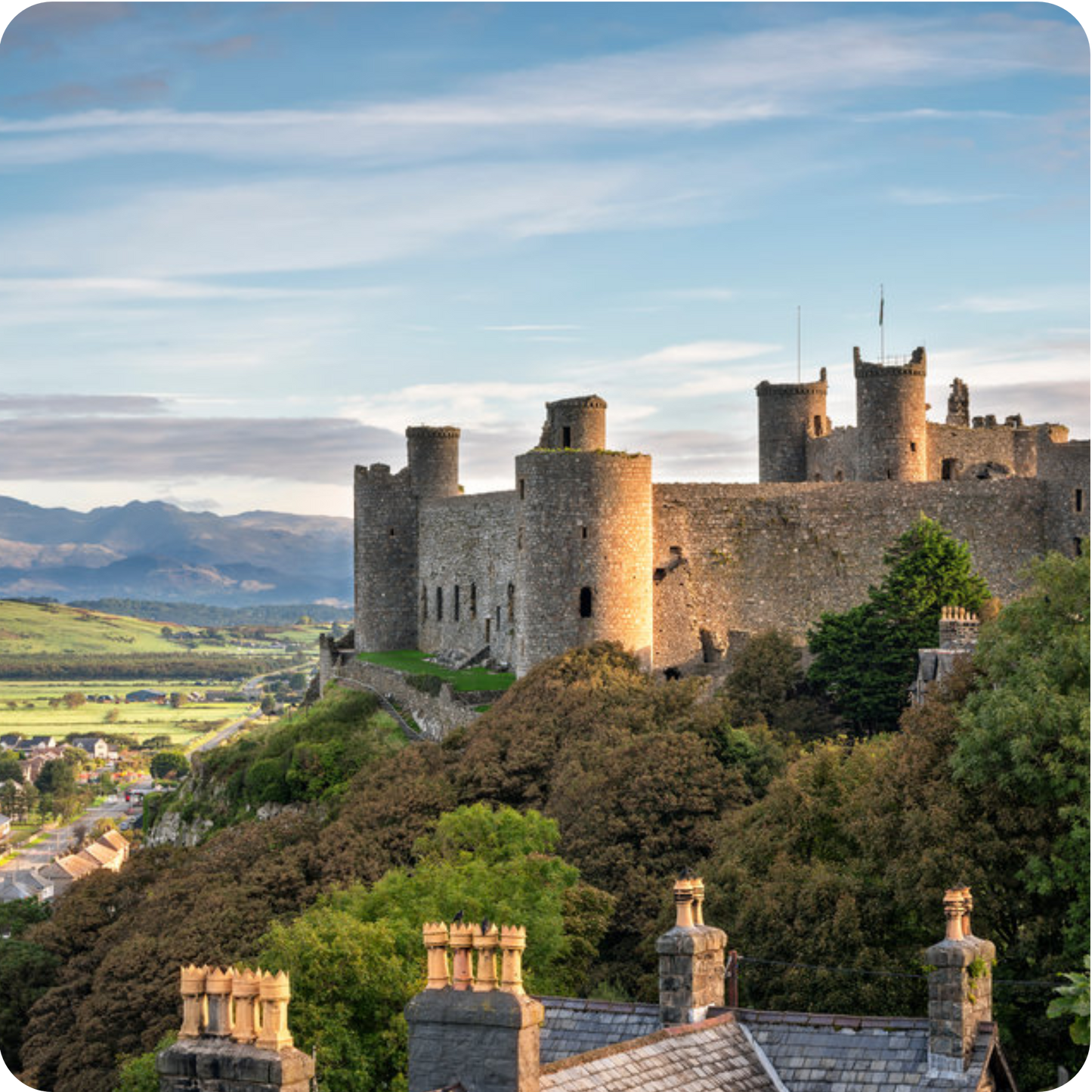
The history is equally deep. Wales has been defending its culture and identity for over a thousand years — against Romans, Anglo-Saxons, Normans, and the English crown. The castles scattered across the landscape aren't just scenic backdrops. They're the physical record of that struggle — some built by Welsh princes to defend their territory, others built by English kings to subdue it. Caernarfon Castle, where Edward I declared his son the first English Prince of Wales in 1284 in a calculated act of political theatre, still dominates its harbour town today. The Welsh have never entirely forgiven him — and the story, when you're standing there looking up at it, is all the richer for that.
The landscapes alone would justify the trip. In the north, Eryri — known in English as Snowdonia, though the Welsh name meaning "abode of eagles" is considerably more evocative — is a national park of extraordinary drama. Snowdon itself, at 1,085 metres the highest peak in Wales and England, is ringed by glacial lakes, mountain passes, and valleys that on a clear winter morning, with snow on the peaks and cloud in the valleys, look like somewhere the ordinary rules of the world don't apply.
In the south, the Brecon Beacons offer gentler but no less beautiful moorland, dramatic waterfalls, and ancient market towns. It's one of Europe's best designated Dark Sky Reserves — on a clear night, the stars here are something you'll genuinely remember. And the coast: Pembrokeshire's beaches look implausibly tropical in summer, the Gower Peninsula — the first place in Britain to be designated an Area of Outstanding Natural Beauty — has clifftop walks and hidden coves that most visitors to Britain never discover, and the Llyn Peninsula stretches into the Irish Sea with tiny villages and ancient pilgrimage routes that feel untouched by the modern world.
Culturally, Wales punches well above its weight. Tintern Abbey, in the Wye Valley, is one of the most beautiful ruins in Britain — a vast roofless Gothic church in a river valley so extraordinary that Wordsworth wrote a poem about it and Turner painted it repeatedly. Portmeirion is something else entirely: an Italianate fantasy village built on a Welsh peninsula by an eccentric architect between 1925 and 1975, so surreal it became the setting for cult TV series The Prisoner, and unlike anything else in Britain. Hay-on-Wye, the tiny border town that reinvented itself as the second-hand book capital of the world, hosts a festival that Bill Clinton once called the Woodstock of the mind. And Conwy — a medieval walled town with a castle, a harbour, and streets barely changed in six centuries — is the kind of place that makes you feel history is still happening.
Visiting Wales from London is absolutely possible independently — but it requires either a car or a significant amount of planning, and often both.
The train from London gets you to Cardiff in around two hours, which is a great start. Cardiff itself is a compact, walkable, genuinely wonderful city — a Victorian arcade-lined centre, a castle in the middle of the city, and a food scene that has come on enormously in the last decade. It's worth a day of anyone's time. But Cardiff is the beginning of Wales, not the heart of it.
Getting from Cardiff to Snowdonia by public transport is a project. Getting to Tintern Abbey, Portmeirion, the Brecon Beacons, or the Pembrokeshire coast without a car involves combinations of slow rural buses, infrequent trains, and a level of flexibility that simply doesn't suit most travellers visiting Britain on a fixed schedule. Wales's greatest treasures — the mountain passes, the ruined abbeys, the hidden coastal villages — are almost always off the rail network entirely.
Hiring a car solves the access problem but introduces new ones: narrow rural lanes, limited parking in popular spots, unfamiliar road signs in Welsh, and the not-insignificant reality that if you're driving, you're not looking at the view. The Brecon Beacons, experienced through a windscreen while worrying about sat nav, is a lesser version of the Brecon Beacons.
The simplest, most rewarding way to visit Wales from London — particularly if you want to cover serious ground in a meaningful amount of time — is a small-group guided tour. Not a coach tour of fifty people following a flag. A proper small-group tour in a comfortable minibus, with a knowledgeable guide who knows these places inside out, where the planning, driving, accommodation, and routing are all done for you before you even pack a bag.
This is exactly what our Best of Wales tour from London is designed to be. Over five days, you travel from London into the heart of Wales and back — covering north, south, and the wild landscapes in between, staying in well-chosen accommodation, with a guide whose job is not just to drive but to bring the whole thing to life. The castles, the history, the language, the landscape, the stories that don't make it into the guidebooks — all of it, without a single logistics headache.
The tour also departs from Cardiff for those already in Wales, meaning it works equally well as our Best of Wales tour from Cardiff — a four-day version that picks up where London leaves off.
What our guests tell us, consistently, is that they see far more of Wales than they could have managed on their own — and that they actually enjoy the journey, rather than spending it navigating. When someone else is driving the mountain passes, you can look at the mountains.
A well-designed Wales tour from London should cover the full breadth of what the country has to offer — not just the famous names, but the places in between that most independent travellers miss. On ours, that means castles and coastline, national parks and harbour towns, Tintern Abbey at dusk and Snowdonia at dawn. It means stopping where the view demands it, eating where the locals eat, and having a guide with genuine knowledge of Welsh history, culture, and language rather than a script.
It also means small groups — ours are capped to ensure everyone has a genuine experience rather than a crowd one. Wales is not a country that rewards being rushed or herded. It rewards attention, slowness, and the willingness to go slightly off-route when something worth seeing appears around a corner. A small group makes that possible. A large one doesn't.
It's technically possible to do a day trip to Cardiff from London. It is not possible to do justice to Wales in a day. The country is too varied, too layered, too surprising for that. The north and the south feel like different countries. The coast and the mountains feel like different worlds. The history and the culture — the language you'll hear in the village pubs of Gwynedd, the male voice choirs that still rehearse in the valleys on Wednesday evenings, the ancient stories embedded in every place name — take time to reveal themselves.
Give Wales five days and it will give you a great deal in return. We've been running tours here for years, and it remains one of the most consistently surprising destinations we visit — the one where guests most often tell us they hadn't expected to be so moved. There's something about Wales that gets under the skin in a way that's hard to predict and impossible to fake.
The red dragon on the flag has been there for over a thousand years. It's been waiting patiently. And it's worth the journey.
Our Best of Wales tour from London runs throughout the year and departs from central London. The tour is also available as a four-day tour from Cardiff for those already based in Wales or arriving independently. Small groups, expert guides, hand-picked accommodation, and not a logistics headache in sight.
Browse the full itinerary and availability — Wales is closer than you think, and considerably more extraordinary.
Availability update (Feb 2026): Some tours have already sold out. Book early to avoid disappointment.